The Truth Behind T-day
Or how to torture your family with party games and historical honesty

My brother married into a family that likes games and quizzes. Or perhaps it is mostly his father-in-law. Every holiday the man called “Papa” by his grandkids writes up a quiz.
This is how we end up sitting around the living room trying to guess what year the Christmas carol “Silent Night” was written (1818), or what the state bird of Washington is (American Goldfinch).
Annoying for me, my brother tends to get these questions right. I hate that.
For the past decade or so, I’ve been educating myself on the true history of the US—which varies wildly from what I was taught as a child, or even as an undergrad history major. I wanted to bring what I was learning to our Thanksgiving table.
Instead of the rant or lecture I was inclined to give, I wrote a quiz.
This was seven or eight years ago—the kids in the family were all pre-teens. When they heard there was a new quiz, they got excited.
Only this quiz was a problem for them.
The quiz was a problem for us all, because no one knew the answers. Not even my brother knew.
When was the first official Thanksgiving celebrated?
Not in 1621.
What were the first settlers called?
Not pilgrims.
Where did these new settlers land when they first arrived?
Not Plymouth Rock.
What did they eat?
Not mashed potatoes, cranberry sauce, or pie (there may have been turkey; there definitely was deer).
With each failed question, the frustration mounted. Finally, my 11-year old niece burst out:
“We get it, we get it—IT’S ALL A LIE.
And with that, we had our winner for the night. The one who said the truest thing of them all.
It’s all a lie.
A lie meant to give us a national mythology we can feel good about. As opposed to what actually happened: land theft and genocide.
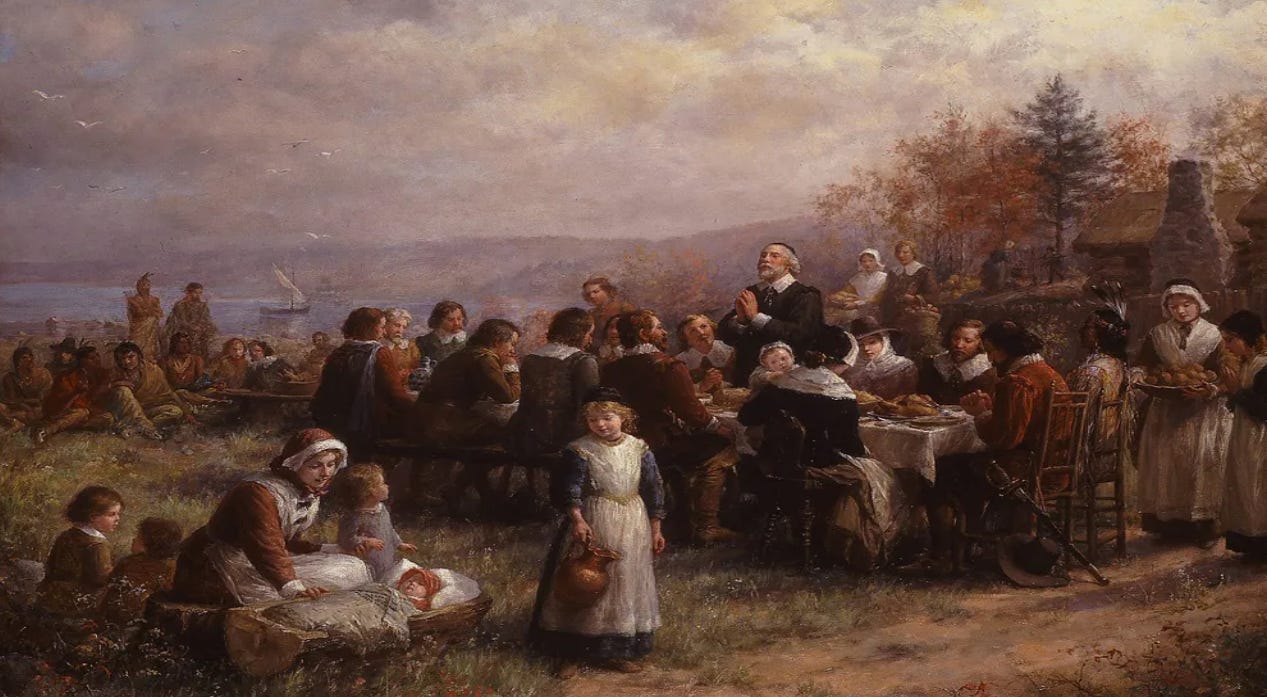
I don’t begrudge anyone who engages in this day—it used to be my favorite holiday.
I liked having a holiday that was more about being together than about buying presents. I like the coziness of it. I like apple pie for breakfast the following day.
The past few years, I’ve stepped away from Thanksgiving. I want to start a new tradition—a harvest dinner to take place in October, when it is actually harvest season, the produce is bountiful, and you might be able to set up outdoors.
Of course, my choosing to opt out or change the date does not change history.
But each year I try to do something. Some years I’ve volunteered at the Native Art Market at the Duwamish Longhouse, the local community center for Seattle’s first people. Some years I’ve educated myself about the Indigenous history of my area, which has changed how I view the landscape around me. I like to participate in the annual Rethinking Thanksgiving webinar and make a donation. This year I’m sharing this story with you.
People have told me they feel uncomfortable with these stories and don’t want to deal with them, and I understand that. But I find I feel better knowing the truth and letting it change me and how I see the world. I cannot alter the past, but I can try to make positive change going forward.
That eleven-year-old niece who figured out the quiz is applying to be a congressional intern next year, I hope she remembers the truth of our beginnings and that they change the way she sees our world too. We need as many clear-eyed people as possible.
The quiz I put together is below, in case you want to shake up your traditions and irritate your family in the name of historical accuracy and accountability. I recommend giving it a try. It’s not the most fun game, but it may be the most conversation provoking.
It’s good to have some perspective, along with your pie.
Perspective:
The Indigenous population of North America was estimated at 15 million people before colonization (1600). By 1900, their numbers had dropped to less than 250,000.
Imagine 90% of your people—men, women, children—wiped out by war, disease (sometimes intentionally spread), murder, relocation to areas away from traditional food sources, forced intermarriage, starvation, rape, and kidnapping. Imagine the trauma.
Indian boarding schools—where stolen children were confined to strip them of their culture—are riddled with tiny graves.
Indigenous communities in the US often refer to Thanksgiving as the “Day of Mourning.”
When did the first Thanksgiving take place?
Truth: No one knows when the “first” thanksgiving occurred. People have been giving thanks for as long as people have existed. Communities around the world celebrate harvest seasons. In Indigenous culture, the ethos of thanksgiving is woven into every day.
While Americans like to point to 1621 as the first Thanksgiving, the holiday wasn’t officially celebrated until many years later. Sarah Josepha Hale, the first female editor of a major US magazine spent years lobbying for a celebration to “offer to God our tribute of joy and gratitude for the blessings of the year.” (She also, oddly, is author of the nursery rhyme “Mary Had a Little Lamb”).
In 1863, Abraham Lincoln agreed to establish a national day of Thanksgiving. The Civil War had divided the country, driving friends and families apart. Lincoln invented a holiday—and manipulated a story about “Pilgrims and Indians” eating happily together—in attempt to bring people together.
Who were the settlers who had come to America? What were they called?
Truth: The Plymouth settlers did not refer to themselves as “Pilgrims.” Most of those who arrived here from England were religious dissidents who had broken away from the Church of England. They called themselves “Saints.” Others called them “Separatists.” (Or, as my British friend likes to say: “They were religious nutters and Europe was glad to be done with them!”).
Some of the settlers were “Puritans.” But it wasn’t until around the time of the American Revolution that the name “Pilgrims” came to be associated with the Plymouth settlers.
When the Settlers landed, where did they first step foot on American soil?
Truth: When the colonists landed, they sought out a sandy inlet to beach the little shallop boat that carried them from the Mayflower to the mainland. This shallop would have been smashed to smithereens had they tried to dock at a rock.
Later, Plymouth settlers built their homes just up the hill from the rock, but there is no mention of it in records from that time. It was first referred to in a town surveying record in 1715, nearly 100 years after the landing.
How did the settlers get corn?
Truth: Just a few days after landing, a party of about 16 settlers led by Captain Myles Standish followed a Nauset trail and came upon an iron kettle and a cache of Indian corn buried in the sand.
They made off with the corn and returned a few days later with reinforcements. This group “found” an even larger store of corn (likely seed corn being stored for planting the following spring), and took it. They also “found” several graves, and, according to Mourt’s Relation (A Journal of the Pilgrims at Plymouth from 1622), they took some of the prettiest things.
The natives in that area did not soon forget that the settlers had stolen their corn and ransacked their graves.
What happened on that first Thanksgiving in 1621?
Truth: There was a feast, just not the way we’ve been taught about it. The settlers were celebrating their harvest, but they didn’t invite the Indians. As part of their celebrations, they shot off their guns (some people say they were trying to hunt duck or other birds).
The Wampanoag—the Indigenous peoples in that area—were worried the settlers were going to attack them. So they came with 90 warriors to see what was going on. They stayed for three days, to make sure the settlers weren’t mounting an attack.
Once they realized how little food the settlers had, they went hunting and returned with five deer and lots of wild birds. There was a feast, but the Wampanoag brought most of the food.
What did the settlers and the Wampanoag eat at that first harvest feast? Was there turkey, potatoes, cranberry sauce, and pie?
Truth: Both written and oral evidence show that what was consumed at the harvest festival in 1621 included venison (Massasoit and his people brought five deer); wild fowl; cooked and mashed pumpkin; and quite possibly nasaump—dried corn pounded and boiled into a thick porridge.
At that time of year, fresh fruit would have been out of season. It would have been too cold to dig for clams or fish for eels or small fish. There were no boats to fish for lobsters in rough water that was about 60 fathoms deep. There was not enough of a barley crop to make a batch of beer, nor was there a wheat crop. Potatoes and sweet potatoes didn’t come from the south up to New England until the 18th century. Cranberry sauce and pumpkin pie would have both needed sugar, which was not available. Half of the settlers had died the prior year and pickings were slim.
I have another newsletter. It’s about fostering joy, self care, pleasure, and delight—because those of us grappling with hard stuff need to balance it out with FUN. Check it out. And if you sign up for a paid subscription here, shoot me a note and I’ll gift you a free subscription to enJOY, if you would like. This is all about walking a middle path: work and play, dark and light. Thanks for reading along.

This is so enlightening. Thank you.
Tara, you want to celebrate Canadian Thanksgiving, which is all about the harvest. And the second Monday in October - come on up, there is usually lots of food - I don't do turkey anymore (save for Christmas), I usually do ham, lots of veggies, roast or scalloped potatoes and apple pie or pumpkin pie with squirty cream. (or both)